
Great Power Politics and The Fourth Industrial Revolution: The Geo-Economics of Technological Sovereignty
Published 2023-03-29
Keywords
- Great Power Politics,
- Fourth Industrial Revolution,
- Geo-economics,
- Technological Sovereignty
Copyright (c) 2023 Mukhtar Imam (Author)

This work is licensed under a Creative Commons Attribution 4.0 International License.
Abstract
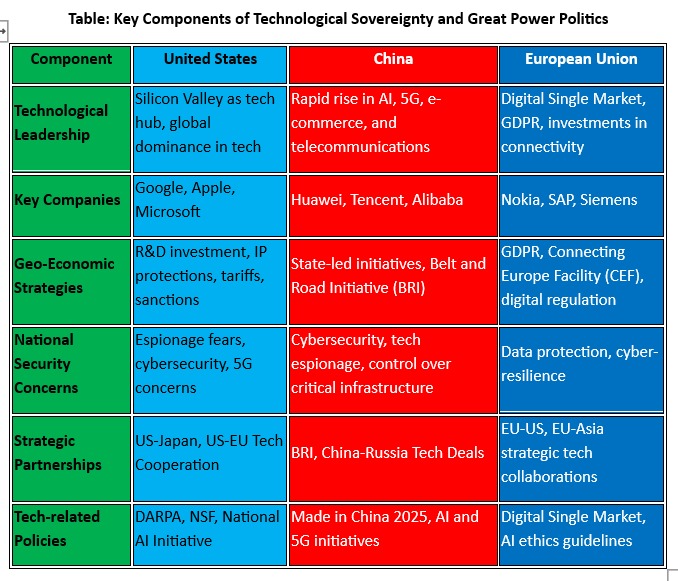
The Fourth Industrial Revolution (4IR) is reshaping global power dynamics through technological innovations such as artificial intelligence (AI), blockchain, and the Internet of Things (IoT). This paper explores the geopolitical implications of 4IR, particularly focusing on the concept of technological sovereignty and its impact on great power politics. As nations compete for technological supremacy, their strategies for achieving and maintaining control over critical technologies have become central to both national security and economic policies. This study adopts a qualitative research approach, employing case study analysis to examine the technological strategies of leading global powers, including the United States, China, and the European Union. Additionally, document analysis is used to explore policy reports and academic literature related to technological sovereignty, 4IR, and geopolitical rivalries. Thematic and comparative analyses are utilized to identify key patterns in the strategies of these powers, highlighting the intersection of technological competition, national security, and economic strategies. The findings of this research underscore the importance of technological sovereignty in the context of 4IR and provide insights into how nations navigate the complex terrain of global technological leadership.
References
- A. da Ponte, G. Leon, and I. Alvarez, “Technological sovereignty of the EU in advanced 5G mobile communications: An empirical approach,” Telecomm. Policy, vol. 47, no. 1, 2023, doi: https://doi.org/10.1016/j.telpol.2022.102459.
- E. Schneider, “Germany’s Industrial strategy 2030, EU competition policy and the Crisis of New Constitutionalism. (Geo-)political economy of a contested paradigm shift,” New Polit. Econ., vol. 28, no. 2, pp. 241–258, 2023, doi: https://doi.org/10.1080/13563467.2022.2091535.
- V. Eatough and L. Tomkins, “Qualitative methods,” in Language and Emotion: An International Handbook, vol. 1, London, United Kingdom: De Gruyter, 2022, pp. 163–182. doi: https://doi.org/10.1515/9783110347524-008.
- L. Levin and S. Forward, “Explaining Data Analysis Using Qualitative Methods,” in International Encyclopedia of Transportation: Volume 1-7, vol. 7, Swedish National Road and Transport Research Institute, Sweden: Elsevier, 2021, pp. 107–112. doi: https://doi.org/10.1016/B978-0-08-102671-7.10668-2.
- C. Alfonso and Á. Antelo, “Quantitative and qualitative methods, primary methods,” in Environmental Toxicology, Plaza Santo Domingo 20-5a, Lugo, 27001, Spain: De Gruyter, 2018, pp. 58–90. doi: https://doi.org/10.1515/9783110442045-003.
- M. Boumezrag, “Qualitative methods and mixed methods,” in Translational Interventional Radiology, Medstar Georgetown University Hospital, Washington, DC, United States: Elsevier, 2023, pp. 233–234. doi: https://doi.org/10.1016/B978-0-12-823026-8.15001-1.
- I. Tshabangu, S. Ba’, and S. M. Madondo, “Qualitative Methods in Research: Alternative Approaches and Navigating Complexities,” in Research Anthology on Innovative Research Methodologies and Utilization Across Multiple Disciplines, Leeds Trinity University, United Kingdom: IGI Global, 2022, pp. 587–603. doi: https://doi.org/10.4018/978-1-6684-3881-7.ch030.
- A. Cissé and A. Rasmussen, “Qualitative Methods,” in Comprehensive Clinical Psychology, Second Edition, vol. 3, Fordham University, Bronx, NY, United States: Elsevier, 2022, pp. 91–103. doi: https://doi.org/10.1016/B978-0-12-818697-8.00216-8.
- K. Malec and D. A. Belluck, “Scientific library research for risk assessment,” in A Practical Guide to Understanding, Managing, and Reviewing Environmental Risk Assessment Reports, University of Minnesota, United States: CRC Press, 2001, pp. 447–455. [Online]. Available: https://www.scopus.com/inward/record.uri?eid=2-s2.0-85056060576&partnerID=40&md5=38e85e8c68df93e7f2e63e74ed3a3078
- A. B. Antipov, “Achieving technological sovereignty through unrelated diversification of state corporations: The case of Rosatom,” Vopr. Ekon., vol. 2025, no. 3, pp. 76–96, 2025, doi: https://doi.org/10.32609/0042-8736-2025-3-76-96.
- V. A. Yasinskii and M. Y. Kozhevnikov, “The Struggle for Technological Sovereignty: China’s Experience and Lessons for Russia,” Stud. Russ. Econ. Dev., vol. 34, no. 5, pp. 704–712, 2023, doi: https://doi.org/10.1134/S1075700723050167.
- C. March and I. Schieferdecker, “Technological Sovereignty as Ability, Not Autarky,” Int. Stud. Rev., vol. 25, no. 2, 2023, doi: https://doi.org/10.1093/isr/viad012.
- T. Gareev, “Technological sovereignty: From conceptual contradiction to practical implementation,” Terra Econ., vol. 21, no. 4, pp. 38–54, 2023, doi: https://doi.org/10.18522/2073-6606-2023-21-4-38-54.
- D. A. Degterev, D. A. Piskunov, and A. A. Eremin, “U.S. – CHINA RIVALRY IN LATIN AMERICA: AT THE ORIGINS OF TECHNOLOGICAL DECOUPLING,” Polis. Polit. Stud., no. 3, pp. 20–38, 2023, doi: https://doi.org/10.17976/jpps/2023.03.03.
- A. Russo, “Strategic Industries Between Geopolitical Instability and Back-Reshoring. The Restructuring of Global Value Chains in the Semiconductor, Biomedical and Pharmaceutical Industries,” Industria, vol. 44, no. 2, pp. 345–380, 2023, doi: https://doi.org/10.1430/108684.
- V. J. Del Casino, L. House-Peters, J. W. Crampton, and H. Gerhardt, “The Social Life of Robots: The Politics of Algorithms, Governance, and Sovereignty,” Antipode, vol. 52, no. 3, pp. 605–618, 2020, doi: https://doi.org/10.1111/anti.12616.
- K. P. Stozhko, S. N. Nekrasov, D. K. Stozhko, A. V Shilovtsev, and T. N. Makarova, “The political economy of technological sovereignty: On the transformation of the concept into the scientific category,” in E3S Web of Conferences, L. O., I. S., N. O., K. V., and R. A., Eds., Ural State Agrarian University, Yekaterinburg, Russian Federation: EDP Sciences, 2023. doi: https://doi.org/10.1051/e3sconf/202339505005.
- M. Imam, “Sudan’s Humanitarian Crisis and The War of Military Elites: Prospects for a Resolution,” Bull. Islam. Res., vol. 1, no. 1, pp. 1–12, 2023, doi: https://doi.org/10.69526/bir.v1i1.332.
- European Commission. (2019). The Digital Single Market: State of Play. Retrieved from https://ec.europa.eu/digital-strategy.
- European Commission. (2020). A European Strategy for Data. Retrieved from https://ec.europa.eu/.
- He, L. (2020). "The Geopolitics of 5G and the US-China Rivalry." Journal of International Affairs, 73(2), 85-102.
- Kissinger, H., Schmidt, E., & Huttenlocher, D. (2021). The Age of AI: And Our Human Future. Little, Brown and Company.
- Mazzucato, M. (2018). The Value of Everything: Making and Taking in the Global Economy. PublicAffairs.
- National Bureau of Asian Research. (2021). China’s Technological Ambitions and the Future of Global Competition.
- Schwab, K. (2016). The Fourth Industrial Revolution. Crown Business.