
Communication to Political Education: How Instagram Transforms Public Knowledge in the Digital Era
Published 2023-03-29
Keywords
- Politics,
- Political Communication,
- Social Media,
- Political Education
Copyright (c) 2023 Rizal Fahmi Muhammad (Author)

This work is licensed under a Creative Commons Attribution 4.0 International License.
Abstract
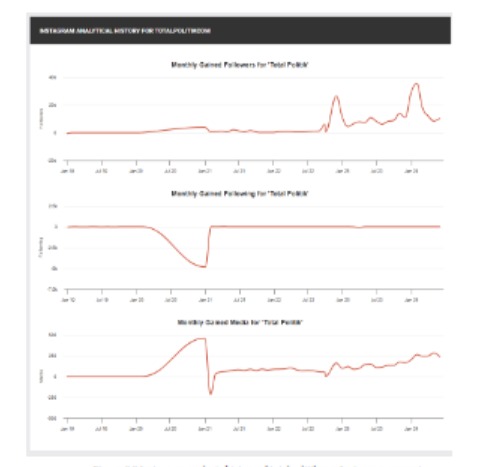
Technology continues to develop and affect several fields, including politics. Political education usually only obtained in formal education such as schools and universities has shifted to social media. The purpose of this research is to explain how social media can increase public knowledge about politics and social media in the digital era has changed its function, which used to be only to communicate with others but now social media can be used for political education. Agenda setting theory is used to find out how Instagram social media on pinterpolitik and totalpolitik accounts educate the public. Methodology This article uses a qualitative description approach with a literature study. Primary data comes from recent books and journals on political education, political communication, and social media. Secondary data comes from observation, the socialblade.com website from July 2019 to January 2024, and social media information. This study's result is that pinterpolitik accounts educate with content that contains interesting infographics, interesting titles, trusted sources, interesting visuals, current political issues, and short, concise, and clear content. Meanwhile, the totalpolitikcom account is slightly different from the pinterpolitik account on Instagram account, the difference can be seen in the uploaded content where they use images and provide captions on the content below the image, and per content uploaded on Instagram, totalpolitikcom uses an average of 2 slides of content. In the future, research on political education through social media can be carried out with a more in-depth analysis and the object of research is not only two accounts, this is because of comparison with other social media accounts that discuss political education.
References
- Almer, T. (2015). Critical Theory and Social Media Between emancipation and commodification (First). Routledge.
- Altbach, P. G. (2007). Student Politics: Activism and Culture. In International Handbook of Higher Education (pp. 329–345). Springer Netherlands. https://doi.org/10.1007/978-1-4020-4012-2_17
- Asy’ari, H., Mellaz, A., Idroos, B. E., Holik, I., Harahap, P., Afifuddin, M., & Sudrajat, Y. (2022). Modul Pendidikan Politik Generasi Muda Melalui Pendekatan Budaya Populer (First). Komisi Pemilihan Umum RepublikI ndonesia. https://siparmas.kpu.go.id/SiparmasFILE/DokumenModul/Dokumen-Modul-1408WIB161421.pdf
- Casas-Mas, B., Fernández Marcellán, M., Robles, J. M., & Vélez, D. (2024). Emotivism Trends in Digital Political Communication: The Influence on the Results of the US Presidential Elections. In Social Sciences (Vol. 13, Issue 2). https://doi.org/10.3390/socsci13020080
- Fyfe, I. (2007). Hidden in the curriculum: Political Literacy and Education for Citizenship in Australia. Melbourne Journal of Politics, 32, 110–134. http://mjp.arts.unimelb.edu.au/index
- Gitiyarko, V. (2023, November 15). Dilema Pendidikan Politik di Indonesia. Kompas. Id. https://www.kompas.id/baca/riset/2023/11/15/dilema-pendidikan-politik-di-indonesia
- Handoyo, E., & Lestari, P. (2017). Pendidikan Politik (First). Pohon Cahaya. https://www.researchgate.net/profile/Eko-Handoyo-3/publication/321039561_Pendidikan_Politik/links/5a0a30efa6fdcc2736dea607/Pendidikan-Politik.pdf
- Hussain, S., Knijnik, J., & Balram, R. (2024). Curriculum wars and youth political education in the UK and Australia — a narrative review. Curriculum Perspectives, April 2021. https://doi.org/10.1007/s41297-024-00226-1
- Juditha, C. (2019). Agenda Setting Penyebaran Hoaks di Media Sosial. Jurnal Penelitian Komunikasi, 22. https://doi.org/10.20422/jpk.v22i2.669
- Lindgren, S. (2017). Digital Media & Society (M. Ainsley (ed.); First). SAGE Publications Ltd.
- López Fernández, V. (2022). Nuevos medios en campaña. El caso de las elecciones autonómicas de Madrid 2021 en TikTok. Universitas, 36, 221–241. https://doi.org/10.17163/uni.n36.2022.09
- Mukarom, Z. (2022). Political Communication Strategies to Increase the Opportunity of Women’s Political Representation in Indonesian Parliament. Journal of International Women’s Studies, 23(1). https://vc.bridgew.edu/jiws/vol23/iss1/30/
- Nafsyah, A. S., Maulidyah, S. R., Nurlia, A. S., & Adhyanti, W. P. (2022). Analisis Konten Media Sosial Instagram By.U Sebagai Media Penyebaran Informasi & Komunikasi. MASSIVE: Jurnal Ilmu Komunikasi, 2(2), 1. https://doi.org/10.35842/massive.v2i2.57
- Nasionalita, K. (2014). RELEVANSI TEORI AGENDA SETTING DALAM DUNIA TANPA BATAS. Jurnal Ilmiah Komunikasi Makna, 5(2), 156. https://doi.org/10.30659/jikm.5.2.156-164
- Park, C. I., & Namkung, Y. (2022). The Effects of Instagram Marketing Activities on Customer-Based Brand Equity in the Coffee Industry. Sustainability (Switzerland), 14(3). https://doi.org/10.3390/su14031657
- Paül i Agustí, D. (2024). Instagram public and private images as an element for the spatial monitoring of tourist behaviour in cities. International Journal of Tourism Cities, 10(3), 1082–1097. https://doi.org/10.1108/IJTC-11-2023-0227
- Ricks, J. I. (2022). Politically Speaking: Ethnic Language and Audience Opinion in Southeast Asia. Journal of East Asian Studies, 22(3), 457–479. https://doi.org/10.1017/jea.2022.20
- Riyanto, A. (2023). Hootsuite (We are Social): Indonesian Digital Report 2023. Hootsuite (We Are Social). https://andi.link/hootsuite-we-are-social-indonesian-digital-report-2023/
- Riyanto, A. (2024). Hootsuite (We are Social): Data Digital Indonesia 2024. Andi.Link. https://andi.link/hootsuite-we-are-social-data-digital-indonesia-2024/
- Roemmele, A., & Gibson, R. (2020). Scientific and subversive: The two faces of the fourth era of political campaigning. New Media & Society, 22(4), 595–610. https://doi.org/10.1177/1461444819893979
- Ruslan. (2000). Pendidikan Politik Ikhwanul Muslimin. Terjemahan Jasiman, dkk. Era Intermedia.
- Soeharto, A. (2011). Urgensi Pendidikan Politik Bagi Perempuan. Muwazah, 3(1), 325–333. https://doi.org/10.28918/muwazah.v3i1.7
- Subekti, D., Mutiarin, D., & Nurmandi, A. (2023). Political Communication in Social Media: A Bibliometrics Analysis. Studies in Media and Communication, 11(6), 299. https://doi.org/10.11114/smc.v11i6.6214
- Sutinen, U.-M., & Närvänen, E. (2022). Constructing the food waste issue on social media: a discursive social marketing approach. Journal of Marketing Management, 38(3–4), 219–247. https://doi.org/10.1080/0267257X.2021.1966077
- Tri, N., Saptadi, S., Atma, U., Makassar, J., Sampe, F., Atma, U., Makassar, J., Nansi, W. S., Atma, U., Makassar, J., Pustaka, S. K., & Pustaka, S. K. (2024). Pendidikan Politik (A. Purnomo (ed.); First, Issue March). Sada Kurnia Pustaka. https://www.researchgate.net/publication/379084841
- Utler, S. J. (2021). Political education of young children: teacher descriptions of social studies teaching for children in 1st–4th grade in Norwegian primary school. Journal of Social Science Education, 20.